

|
|
|
NEWS,
WEATHER, and SPORTS
December,
2007
The
Hour of Arriving
This
lighthouse was the centerpiece of the view from the balcony of
my room at the Hotel Bayerischer Hof (Bavarian Court) in the
island-city of Lindau, Germany. On a large lake called the Bodensee,
or Lake Constance, near the present-day borders of Germany, Austria,
and Switzerland, Lindau’s history dates to Roman times,
growing from a monastery to a fortified city-state almost a thousand
years ago. A fair-sized island—two-thirds of a square kilometer,
or about 170 acres—today Lindau is connected to the mainland
by a causeway, and the city retains a picturesque, medieval atmosphere.
The
clock on the lighthouse shows that it was five o’clock—cocktail
time—and that’s what Brutus and I were celebrating.
After a show the previous night in Oberhausen, we had slept on
the bus in Mannheim, then unloaded the motorcycles and ridden
516 kilometers, 323 miles, through cold, snowy weather along
the Bavarian Alps. Now we were settled into our spacious and
comfortable rooms, with a magnificent view over the lake and
across to the Austrian and Swiss Alps. At the western end of
the lake, where the Rhine flowed out, the sun was still bright.
We clinked our glasses and stood on the balcony taking it all
in.
Perhaps
my favorite part of a long day on the motorcycle is that first
hour of arriving and settling into a hotel, whether humble or
luxurious. It feels so good to pull up in front of the hotel,
kick down the sidestand, and lift a weary leg over the saddle,
still keyed up from the day’s adventures, yet gradually
easing into a more relaxed state of mind. I peel off my gloves,
lift off the helmet, pull out the earplugs, and slowly stretch
my back into an upright posture again. Brutus goes inside to
see about our rooms, while I lazily open the aluminum luggage
cases and unload my soft bags, unhook the duffle from my saddle,
and unzip the tankbag, piling them at the curb. At a hotel sufficiently
luxurious as to provide a bellman, such as the Bayerischer Hof,
I’ll load up the luggage cart (at our hotel in Scotland,
the doorman looked at me blankly when I requested a cart—they
call it a trolley). Piling on my gear, hanging my helmet from
the crossbar, I’ll start adding Brutus’s luggage,
too.
Once
the bikes are parked, we find our way to our rooms and start
the usual sequence of rituals. First unpack the dress-up-for-dinner
clothes (suit and tie in Europe, black cotton shirt and pants
in North America) and hang them in the bathroom, to let the shower
steam out the wrinkles. Clean the helmet’s faceshield with
the “bug rag” I carry in my tankbag, and hang the
grubby white cloth by the shower to be washed later, then draped
over a chair to dry overnight (in plain sight, so you don’t
leave it behind—it’s the kind of thing you miss when
a bug splatters itself across the plastic in front of your eyes).
Finally, spread the luggage bags across the bed and dig out the
plastic flask of The Macallan.
Brutus
will come by my room with a bucket of ice, and I’ll pour
us each a glass, sometimes omitting the ice, on a cold day. (Once
you’ve been chilled to the bone by riding in freezing weather
all day, it takes a long time, and a hot shower, to finally feel
warm again.) After toasting each other with a nod and a smile—a
silent, shared tribute to the day, and to our continued existence—we
admire the view, have a smoke, watch the tour boat come into
the harbor, talk about some of the day’s adventures and
encounters, and look through the photographs we’ve taken.
We settle on a time to meet for dinner, and go off to take care
of our own chores.
Dinner
is always a big event at the end of a long ride. (Like that line
from Byron, “Much depends upon dinner.”) Brutus and
I usually skip lunch, preferring to spend that time riding, and
so arrive at our destination earlier. By late afternoon, we will
be ravenous, but the wait is especially well rewarded in Europe,
where great restaurants are so much more common.
Even
on our first night off in Europe, a week or so before visiting
Lindau, we had ended our day at a fantastic place—the Yorke
Arms, in northern England. The small hotel described itself as “A
Restaurant With Rooms,” and boasted a Michelin star, so
even more than usual, its dining room was an important part of
the destination for Brutus and me.
In
my years of traveling to places both exotic and ordinary, I have
had many bad journeys to great destinations, and plenty of great
journeys to bad destinations. The latter occurs more often in
North America, which is far too large and scattered to have the
concentration of sophisticated accommodations that Europe can
offer. But of course the journeys can be monumentally grand,
especially in the West.
At
the end of the North American part of the tour, my American riding
partner Michael and I had a T-shirt printed up that listed ten
American motels we had stayed at for less than $100 (some of
them much less,
but still nice enough, and I do love being able to park right
in front of my room). The column of motels, towns, and prices
appeared above the slogan, “That’s
The Way We Roll.” While Brutus and I swanned around
between luxurious hotels in Europe, we joked about making a T-shirt
with a list of all the fantastic—and fantastically expensive—places
we stayed there, followed by the slogan, “That’s
The Way We Roll.”
Our
ride to the Yorke Arms in North Yorkshire had been a long day,
but it was one of those journeys where the miles didn’t
begin to tell the story. Anyone who has traveled much in Britain
would agree that 221 miles (353 kilometers) is a substantial
day’s journey under any circumstances, but for Brutus and
me most of those miles were on tiny roads, often only one narrow
lane, further crowded by stone walls, hedges, and woodlands in
crooked lines, with endless blind corners. Pheasants and grouse
started up in front of us from the roadside cover, sometimes
causing us to duck reflexively, and sheep were a constant menace.
Plus there was the occasional Land Rover or farm tractor appearing
from nowhere and occupying most of the road.
We
had started that morning near Jedburgh, in Scotland, waking on
the bus in a quiet lay-by. Our driver, Mark, cut the oranges
in half while I squeezed the juice (into glasses we kept overnight
in the freezer—a recent innovation of mine), the coffee
fragrant as it poured from the excellent little machine that
ground the beans for each cup. While I ate my cereal and bananas,
Mark and Brutus unloaded the bikes, then we got dressed to ride
and gathered our luggage.
|
Setting
off from the bus on a misty morning, in a British motorway
services
(photo
taken by our bus driver, Mark, from his driver’s
seat)
|
That day we rambled down through the Lake District (as pictured
in the previous story, “Above Lake Windermere”),
and some curvy little roads across wide-open moorland, grassy
and treeless, in the Yorkshire Dales. On a bright sunny day,
the stone-built villages and walls, the winding lanes through
spacious countryside, and the variety of scenery from woodlands
to open moors had made for an exciting and enjoyable ride.
To arrive at a luxurious country hotel, the Yorke Arms, in
the hamlet of Ramsgill-in-Nidderdale (a church, the hotel,
and a few cottages, all in stone) nestled in a lush valley,
with a Michelin-starred restaurant, was the proverbial icing.
Brutus
and I have a particular appreciation for good food, perhaps because
both of us do a lot of cooking at home (though I admit with all
humility that Brutus is the more intuitive and sophisticated
chef—I’m just a recipe-follower). Along with our
Alex, Brutus was the first man I knew who would spend hours preparing
a meal for friends and loved ones—and it was from the two
of them that I learned why:
cooking is an expression of love. When Brutus visits me at my
house on the lake in Quebec, if the weather is bad we might spend
hours in the kitchen making ourselves an amazing meal.
For
myself, it’s only in the past ten years that I have taken
any interest in cooking; before that I couldn’t do much
more than boil an egg. That process of learning and refining
techniques in the kitchen parallels my comments about motorcycling
and drumming in a previous story—many things can be learned
that cannot be taught. (My friend Mike Heppner, a novelist and
writing teacher, points out that writing is the same way.)
By
gradually learning to prepare dishes that I liked to eat (and
that pleased my wife), from fish, vegetables, and rice to key
lime pie and chocolate cake, beginning to shop wisely and often
(every day or two, in the European fashion), and moderate heat
and time precisely (a recipe for good drumming, too: heat + time),
I have built up a fair repertoire of simple meals.
That
minor accomplishment not only impresses women no end, it has
changed the way I look at a restaurant menu. Now I automatically
dismiss anything I could make myself, and choose dishes that
are difficult or especially time-consuming to make. The Yorke
Arms menu offered a perfect example of this policy, as I ordered
a scallop soufflé, roast grouse, and a chocolate soufflé (soufflés
are famously one of the hardest dishes to produce successfully,
and grouse is—well, not generally available in my neighborhood
grocery store). The meal was absolutely superb, and a bottle
of great burgundy, Echézeaux, was an ideal complement,
finished perfectly by black coffee and a snifter of Hennessey
XO.
The
Yorke Arms experience was already a dramatic contrast to some
of the utilitarian motels and humble meals Michael and I had
resorted to in North America. Though at the time we had certainly
appreciated those “hours of arriving” too, our destinations
were more-or-less accidental, chosen because they were on our
route, and it was time to stop. In Europe, Brutus was able to
choose a great destination, then design a fantastic route to
get there. It is hard to imagine how an establishment as sophisticated
as the Yorke Arms manages to exist in the wilds of North Yorkshire,
but Brutus and I were glad it did.
The
next day off, between shows in London and Birmingham, carried
us to another fantastic destination. After a long day’s
ride through the West Country, Devon and Somerset—part
of Thomas Hardy’s “Wessex”—along many
more winding little lanes, we rode into the curving gravel drive
of the Buckland Manor in the Cotswolds.
The
evening light was golden on the gardens and the manor house (my
room on the front right, top floor) and neighboring chapel. Built
from the famously buttery local stone, parts of the building
dated back more than a thousand years. At a place like that,
we would carry our drinks with us and go for a walk, take some
photographs, and feel good about life.
Another
unforgettable overnight stop was the Bühlerhöhe Schlosshotel
in Germany’s Black Forest (described glowingly in Roadshow).
During that same magic hour after arriving, I made a journal
note expressing my awareness of these contrasts in my life.
Sometimes
I can only laugh.
After
today, last night, the last two days—almost too
much.
But
really just enough.
By
that I was trying to reconcile playing two hard shows in Rotterdam,
filming for a concert DVD with the attendant pressure to play
well, feeling good about having captured two decent performances
on those nights (a little extra sore, too), then sleeping on
the bus and waking up to ride all day on the challenging roads
of southern Germany and the Black Forest, and finally arriving
at a truly magnificent hotel—where I had been given the
ridiculously large, ornately decorated Presidential Suite. Brutus
and I guessed that upgrade was due to our stay at that same hotel
last tour, when we had complained (okay, I had
complained) about not being able to get a reservation in the
main restaurant. Perhaps they’d made a note that they “owed
us one.” In any case, after those action-packed days and
nights, to stand in that palatial suite and look out at the breathtaking
view was indeed “almost too
much. But really just enough.”
Clearly,
this was not a scene to be taken for granted, and in the same
way the view from my balcony in Lindau had fascinated me, I kept
watching as the sky changed. Again and again I picked up my camera
and tried to capture the ultimate sunset over the Black Forest,
the Rhine Valley, and, in the far distance, the low Vosges Mountains
of French Alsace.
That
evening, I contemplated a title for a story about such contrasts, “Europe
Is Different.” With the intended irony of understatement,
that title seemed to hint at a whole host of differences between
traveling in North America and Europe. Under the title, I added
a wry parenthesis, “(plenty of eggs go in that basket),” and
I was certainly thinking of good eggs.
As I wrote in Roadshow, referring
to Brutus’s and my European travels on the R30 Tour in
2004, “Europe has . . . seduced me.”
|
The
Hour of Arriving 2—Brutus follows me into the arena
in Oslo,
directed
by Michael at the top of the ramp
(photo by Mark)
|
On
a show day, the hour of arriving is completely different. It
is not the end of the day’s labors, but merely the beginning.
Not least, there’s still a three-hour show to
perform. Soundcheck at 5:00 is the first “scheduled activity,” but
there is always plenty to do before that. We like to arrive between
two and three, after pausing just before we pull up at the venue
to call Michael (who handled security in Europe) and let him
know our ETA. Michael will advise us on the easiest way into
the building or parking area, and he or his associate Kevin (former
Canadian soldier, now firefighter and computer forensics expert
in Calgary, Alberta, moonlighting as Michael’s fellow Praetorian
for the European tour) will meet us out front to wave us in.
The
amphitheaters in North America are the nicest to arrive at, because
they are usually in rural areas, so we don’t have to fight
through city traffic, and because they have a private, enclosed
area for the buses and trucks, so I am able to walk freely from
bike to bus to backstage anytime I want. The arenas in North
America and Europe are usually in the middle of a busy city,
and the buses and trucks are often parked on the street or in
a public area. There is no privacy for me outdoors, so if I want
to, say, change the oil in my bike, it takes some . . . logistical
strategy—like at the Ahoy in Rotterdam.
Before
Brutus and I arrived, Michael had Mark park the bus close along
a wall near the backstage entrance, then arranged to have some
free-standing curtains from the building placed at each end of
the bus, between it and the wall. When we rolled up, Kevin pointed
me behind the bus and trailer, and pulled back the curtain at
one end for me to ride through. Thus I had a private area to
work on the bike, hidden from gawkers, rockers, talkers, and
stalkers. (An audience is very good to have when you’re
performing, but not so much when you’re lying on the ground
changing your oil.)
|
Afternoon
oil change in Rotterdam—“Do not look behind the
curtain!” |
In
its way, that first hour at work is almost as special as it is
on a day off. It is not so pleasurable, of course—it’s
work, and there is more urgency to get things done, take care
of business—but there is time for all the chores, and that
is satisfying in a “practical” sort of way. Carry
the luggage onto the bus, unpack the dress-up clothes and hang
them in the locker, clean off the faceshield and hang the rag
to dry—beside the salt-stained stage clothes from the previous
show, dry now and ready to give to Donovan for cleaning, so they
are shoved into the “gig bag” with my used towels
from that show, and my drumming shoes (actually dancing shoes,
inspired by my teacher, Freddie Gruber. When I first studied
with him, back in 1995, he shook his finger at me and said, “Don’t
play drums in sneakers!” Freddie’s method was centered
on teaching me to dance on
the drums, so I tried some soft-shoe dancing shoes, and now I
can’t play properly without them).
I
leave that bag by the bus’s door, ready to go inside later,
then gather the tools, oil, filter, and rags to do the oil change.
Twenty minutes later, with Brutus now working on the other bike,
I have the pleasure of washing my dirty hands and noting the
mileage in my journal (especially satisfied when the interval
is close to my target of 3,000 kilometers between changes).
Then
on to check phone messages, skim through accumulated e-mails,
maybe have a shower and a nap, and before I know it, it’s
soundcheck time. Then dinner with the guys at work, a bit of
quiet time to phone Carrie, read, even close my eyes for a few
minutes, then fifteen or twenty minutes on the little warmup
drumset, change into stage clothes, and on to another show .
. .
When
the show is over, there is another kind of hour of arriving.
As the bus drives away from the venue, and I change out of my
sweaty clothes and into pajama bottoms and a T-shirt, then sit
in the front lounge to enjoy what I called in Roadshow, “my
humble workman’s rewards: a glass of booze and a smoke,” there’s
a similar feeling of keyed-up peace that only lasts a little
while, but feels pretty good.
|
Mark
driving into the night after a show |
The
nature of the reward at each of those hours is the feeling that
you have traveled a long way to get somewhere, and now you’re
there. Such a feeling is necessarily transitory, because all
too soon you’re on your way to somewhere else—another
ride, another hotel room, another show. But when that destination
is home, and
you’ve got more than a few days to spend there, that hour
of arriving can open into a delightful passage of unfenced time.
As
if a long-held breath has been released at last, tension eases,
fatigue slowly melts away—one muscle group at a time, it
often seems. After about two weeks of rest, I notice that one
shoulder will ache for a day, then the other one, then a daily
succession of forearms, biceps, quads, calves, and elbows. Likewise,
the split calluses on my fingers start to itch a little as they
heal over, and my hands don’t look and feel so inflamed
and swollen all the time.
After
the past two years of more-or-less steady work, recording and
touring, there are practical matters to attend to as well—like
visits to the dentist, which may not be delightful as
such, but need to be addressed. Along with getting cars serviced
and mail sorted, I am able to provision my long-neglected kitchen
with all the fresh and varied ingredients I might need to “feed
inspiration”—onion, garlic, dill, tomatoes, multicolored
peppers, lemons, that sort of thing. Just to have them on hand,
so that while I’m cooking, if I think, “hmm, some
fried onions would be good with this,” I can do it.
There
is time for indulgences, too,
like writing these stories. (I have decided to define them as
a combination open letter and “meditation.”) I’m
not sure what they’re “for,” or where they’re
leading me, but I enjoy the process, and I can do it.
Likewise,
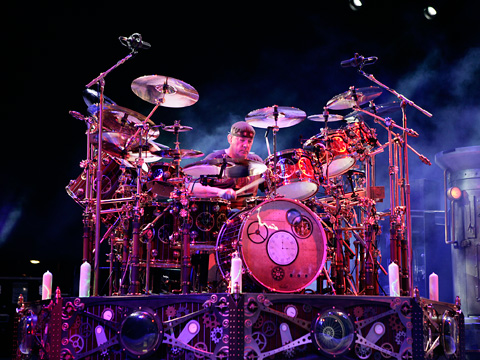
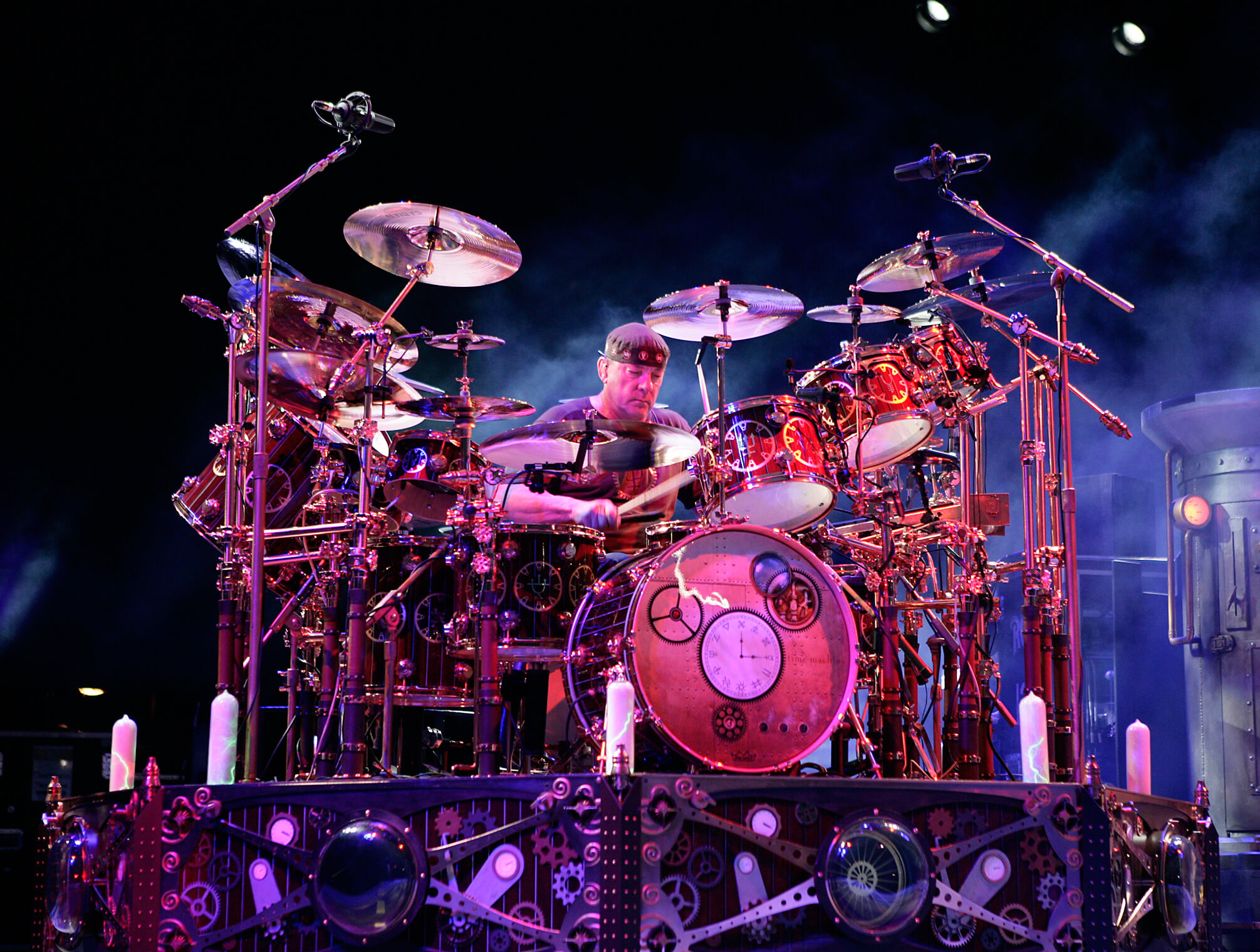
I have ordered 100 postcards, with a picture of me and my drums
on the front, intending to write and mail one as a “thank
you” note to each of the people who sent me gifts on this
tour. (Inevitably, as I traveled around and collected so many
cards and letters in the dressing room case, on the bus, and
in my luggage, some of them went astray—like the card from
the “friendly Floridian,” for example—so I
apologize to anyone I missed, and thank them now.)
Back
in April of this year, just before the Snakes and Arrows tour,
I did a TV interview for the Canadian music channel, MuchMusic.
The cameraman placed the interviewer and me in the rehearsal
hall, in front of my drums, where I had been laboring for several
weeks by then. Some of the interviewer’s questions seemed
to angle toward a certain starry-eyed view of my work, especially
the touring side of it, and I tried to explain to him that I
didn’t consider touring, or even drumming, to be
my life.
He
seemed perplexed, and to appraise me as clearly jaded and cynical,
because his next question was, “When did you start to feel
that way?”
I
paused to think for a couple of seconds, then was glad to feel
the mental light bulb illuminate a true and clear answer. I was
able to answer honestly, “About a month into the first
tour, in 1974.” That really was when I started to feel
that touring was “not enough,” and turned to reading
books as a way to make more use of the days and nights.
Partly
out of sheer contrariness, but partly out of a desire for context, I
often refer to playing the drums, with deliberate disrespect,
as “the job”—hitting things with sticks. Obviously
it means much more to me than that, and has been a central focus
in my life. But still, it seems rather sad to hear anyone say
that their work is their life.
Not
family and friends? Not reading and writing? Not hiking or cross-country
skiing or birdwatching or motorcycle riding or swimming?
Just
work?
I
don’t think so.
Earlier
in the tour, when we played in Portland, Oregon, someone in the
audience had apparently seen that interview, and ventured to
disagree publicly with my opinion on the subject of my life.
Far back on the stage-left side of the house I saw a large sign,
in big block letters, “NP—THIS IS YOUR LIFE.”
Well,
thanks, but no thanks.
Of
course it’s just my opinion, but to me, my life is not
dedicated to the place, but
to the journey, and to the hour of arriving.
All
the while knowing that, all too soon, there will come the hour
of departing.
|
|
|
|