
| |
So
many good things to report, I hardly know where to start. But I
guess that very feeling makes a pretty good beginning.
When
I set out to write a long overdue letter to a friend, I sometimes
start from my last letter to them and catch up from there. Other
times I write about that particular day — its events, weather,
and mood — and work backwards.
This
time I’m going to split the difference, and start with May.
T.S. Eliot famously called April “the cruelest month,” and
if that is so, May must be among the kindest. A line in one of
my favorite songs lately, “We Looked Like Giants” (by
the delightfully named Death Cab For Cutie), goes, “the sugary
smell of springtime,” and May is especially sweet in Toronto.
After
the long insult of an urban winter, and the teasing glimmers of
mild relief among the chills and showers of April, May brings a
rapid segue from spring into early summer. The trees fill in almost
overnight with new leaves of the brightest green, and the front-yard
gardens display their sequence of white, purple, yellow, and pink — from
snowdrops to crocuses to daffodils to tulips.
May
also brings the perfume of lilacs, one of my favorite smells since
childhood. When I lived in Toronto in the ’90s, we had a
row of lilac bushes along the back fence, and I used to pick their
stems and put them on my desk — lush green leaves and pale
purple clusters of blossoms. From time to time I would stick my
nose right into them, and inhale that heady fragrance like a drug.
My
bandmates and I had decided to spend May working together in a
Toronto studio, to refine some of the songs we had worked on long-distance
over the winter, and hopefully to write some new ones. The small
studio was located in an old waterfront area, just a block or so
from Lake Ontario, a remote little corner sidelined by more modern
dock facilities elsewhere. The studio
building itself had been a munitions factory around World War II,
and out front, the wide boulevard of old warehouses was divided
by abandoned railroad tracks. Rising above were the tall concrete
cylinders of a concrete factory and the squat metal cylinders of
petroleum storage tanks. Behind that industrial foreground, traffic
moved across the elevated Gardiner Expressway, and above, in dramatic
contrast, the modern skyline of Toronto’s downtown rose up
shining, dominated by the CN Tower.
One
afternoon the three of us and a couple of our crew members gathered
by the glass doors to watch a thunderstorm loom in across that
skyline, magnesium flares of lightning and simultaneous shockwaves
of thunder. As I was passing by in the hallway, Alex called out, “Come
on, we’re having a storm party!” and we all crowded
into the entranceway, sheltered from the teeming rain, for a better
view of the fireworks — “Wow, did you see that one?”
For
most of the past six years I have lived in Southern California,
where thunderstorms are extremely rare — the Mediterranean
climate lacks the necessary cold fronts colliding with warm air
masses — and I miss those spectacular displays of son
et lumière.
When
we weren’t busy watching thunderstorms, or eating lunch,
we did a lot of work. I had a little room in a corner of the building
where I could tinker with lyrics; Alex and Geddy were set up in
the control room with guitars, computers, and vocal mic, and my
drums were in the recording room. When I had had enough of struggling
to put lyrical words together, I could escape to the drums and
play along with rough versions of the songs when the guys were
ready to hand them over. As I mentioned in the last report, I have
been very enthusiastic about drumming lately, and I did find myself
exploring new ways to put drum parts together, and new approaches
to playing them. (Not really “new,” of course, but “new
to me.”)
By
the end of May, we had eight songs that we all liked, and I had
worked out drum parts for six of them. So the work had gone well,
but it had not been easy. This excerpt from an e-mail I wrote to
my friend Matt Scannell tells an illustrative story of creative
life, and makes a simply amazing segue
into my next story . . .
The
actual work has gone pretty well, though not without angst.
There
was this one song . . .
As
he often does, Geddy had gone through a set of lyrics with some
music he and Alex had “jammed out.” Along the way,
he picked the lines that “worked,” and left out a bunch
of others. Fine enough, of course, and that method often gives
the words a new twist, but then it’s up to me to try to reshape
the remains so it makes sense.
In
this case, the song in question already had a scattered theme,
and tenuous “sense,” and as I tried to stitch together
the “new version,” I just couldn’t get it to mean anything.
Or even to seem to
mean anything. A little obscurity is fine, of course, but there
has to be some kind of inner logic there for me. Like I said to
Lerxst, “Even an abstract painting is supposed to be of something.”
So
chipping away at that and getting nowhere was getting me down,
and one day I found myself driving into work with a sense of dread,
knowing I had to face that knotty mess again. I didn’t remember
ever feeling that way about writing before, and all at once I fell
into this “all washed up” state of mind, convinced
I just couldn’t do it anymore, and I should just give up.
(I’m sure you know the feeling — all songwriters do!)
And
wouldn’t you know it? That day, I not only fixed up the problems
with that song in a few minutes, but also started from scratch
on another one that may well be the “masterpiece” of
this album.
When
I showed it to the guys, they were so enthusiastic I could hardly
believe it, and ever since they have been all fired up to get the
other songs tidied up and put away so they can get to work on music
for this one.
So
that changed my world!
.
. .
Ah,
the ups and downs of geniushood, huh?
[Tongue
in cheek, of course.]
So
. . . I was writing to Matt that day because he and I were also
working on some songs together. As told in Traveling Music, Matt
and I became friends a few years ago by a fairly remarkable set
of circumstances, ignited by my admiration for Matt’s work
with Vertical Horizon. Since we were both immigrants to Los Angeles
(Matt grew up in Worcester, Massachusetts), and shared an interest
in music, fine watches, fast cars, silly humor, and each other’s
lives and work, he and I often got together for a hike in the Santa
Monica Mountains, or a burger at Broadway Deli. (Or a rapid drive
up to Laguna Seca for the American Le Mans Series races last October — but
that, it occurs to me, is a story all its own. I’ll try to
write it one of these days.)
Late
in 2005, Matt and I started working on a song together, with lyrics
I wrote especially for Matt’s voice — literal and metaphorical.
Matt suggested I might like to play drums on that song, and when
I agreed to that, he started sending me demos of other songs he
thought I might like to play on. (Trickster!)
So
while I was in Toronto working on Rush songs, I was also “moonlighting” on
three of Matt’s songs, playing to his demos and working out
drum parts for them. A couple of nights a week Alex and I worked
late recording sketches of drum parts for our new songs, so I could
hear how they worked, and I started squeezing in a couple of takes
of one of Matt’s songs, too. Through the miracle of modern
technology, I was able to e-mail those recorded sketches to Matt,
and collect his comments as I went along.
Thus
it came to pass . . . on June 14, 2006, at Capitol Records Studio
B in Hollywood (Hollywood and Vine, in fact), I recorded three
songs for Matt’s upcoming Vertical Horizon album. Even the
drumset I played that day has a rich back-story, starting about
two months earlier.
While
considering the logistics of getting my drums from Toronto to Los
Angeles and back, I was talking with my friends at Drum Workshop,
and they pointed out that some busy drummers have a different drumset
for each coast, stored and ready when they need it. Since I lived
on the West Coast now, maybe I should have a “West Coast
kit.”
Well,
yeah, obviously. So in talking to John Good at DW, we decided to
build a pure “recording” kit, with basic chrome hardware
and a natural wood finish. John designed an elaborate combination
of laminates and reinforcement hoops for each individual shell,
and Garrison, the company’s “artists’ rep,” started
organizing the hardware. I would ship down my own set of Paragon
cymbals (properly worked-in after the R30 tour) and a few favorite
snare drums, plus a set of the “drum boards” on which
my kit is mounted, so the stands could be screwed right into it.
That
was going to be helpful for another reason. My invaluable and expert
drum tech, Lorne (Gump) Wheaton, was going to be starting a tour
with Steely Dan’s great drummer, Keith Carlock, just before
my sessions with Matt, so he wouldn’t be able to be there.
However, Garrison offered his assistance, and I also called upon
my friend Chris from Sabian’s Los Angeles office. Chris had
traveled with Lorne on the “S.S. Professor” tour the
previous year, demonstrating my “R30” drumset all around
the U.S. and Canada, so he knew the setup as well as anyone else
apart from Lorne. Chris is a fellow motorcyclist (Ducati Multistrada),
and on June 7 he and I rode up the Pacific Coast Highway to the
Drum Workshop factory, to see how the new kit was coming together.
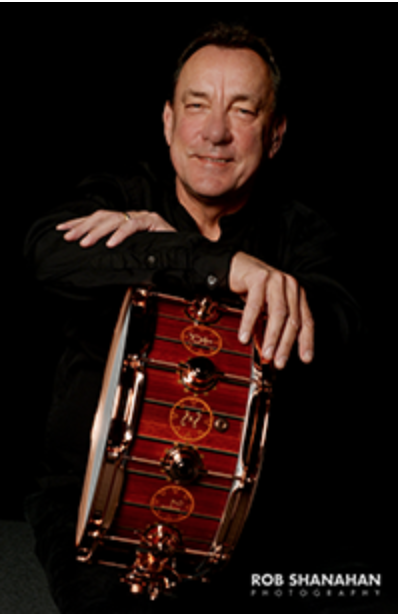
Lorne
and I had decided on a “tobacco sunburst” finish, like
a classic guitar, but when John chose “curly maple” for
the base of it, and master painter Louie applied his artistry,
they looked way better
than I had imagined. And once I started playing them, John’s
painstaking design of their acoustic properties paid off, too — people
coming in from outside the showroom remarked on how good they sounded
even from outside.
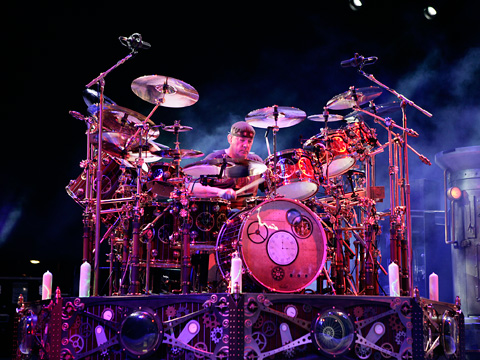
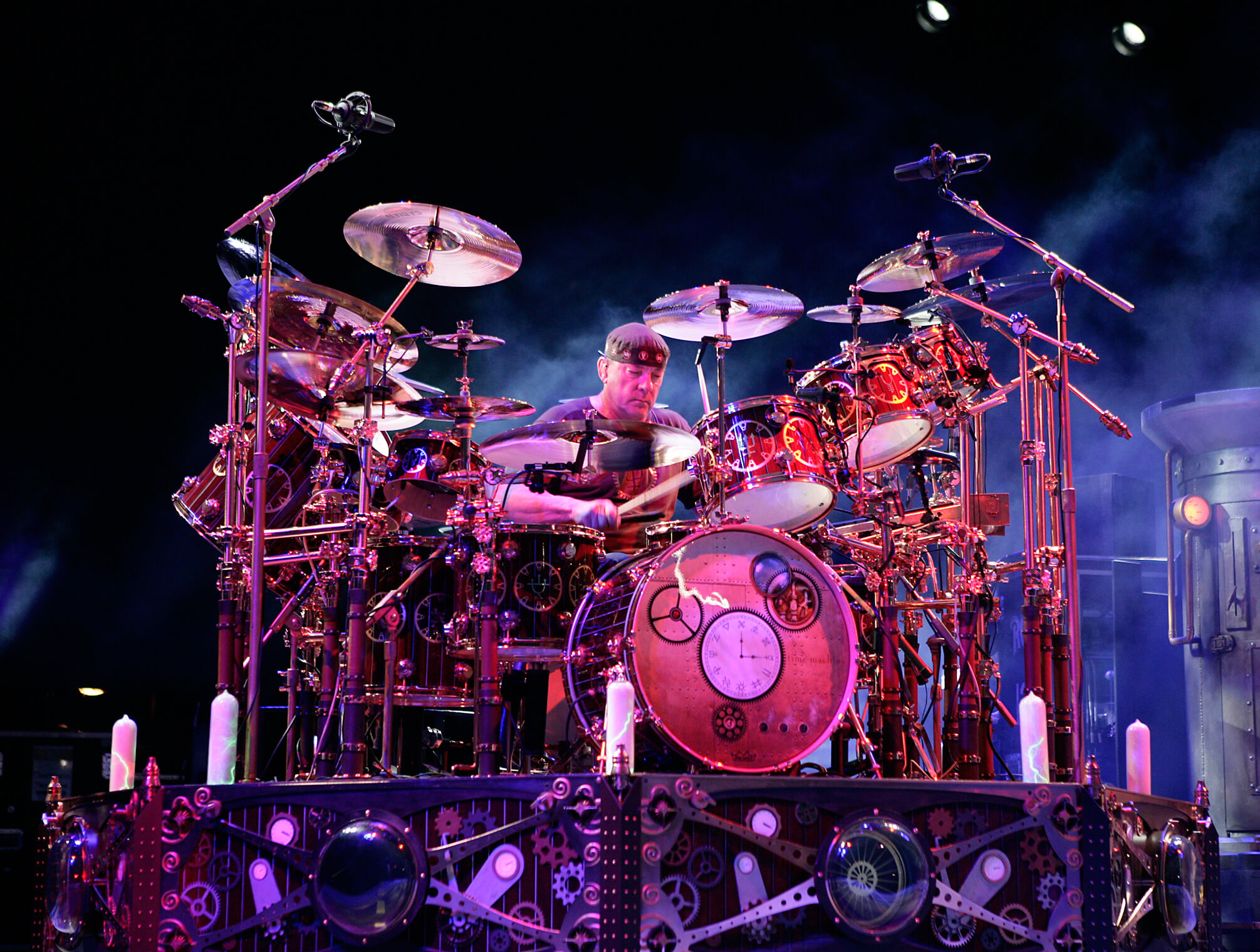
I
haven’t illustrated my previous newsletters with photographs,
but this seems a good one to start with — talk about a picture
being worth a thousand words.
With
Garrison and Chris as my “pit crew,” we scheduled a
rehearsal on the day before the session, for last-minute tuneups
of both drumset and drummer. On the 14th, we all showed up early
at Capitol Records Studio B. Going in, I felt energized and positive,
excited and eager, but still tense and grimly focused on the big
job at hand. As I had written to a friend the day before,
I’m
looking forward to that — though with a little trepidation,
as I will be called upon to produce three “masterpieces” in
one day. That’s never easy! And worse, you can never feel
100% sure you’ll be able to do it.
Ah,
but if you pull it off, it feels good!
The
hallways at Capitol were lined with black-and-white photographs
of others who had recorded there — Big Frank, Nat King Cole,
Bobby Darin, Judy Garland, Miss Peggy Lee, Gene Vincent — and
that too was a little daunting. But exciting, too, and reflected
the “historical” nature of our session, at least for
me.
As
a drummer, I have always been fully satisfied with the range of
music I get to play with Rush, and have rarely felt moved to work
with other musicians — a couple of tracks with bassist Jeff
Berlin years ago, a couple of “guest percussion” spots
with Canadian bands, and the Buddy Rich tribute albums, that’s
about it.
This
collaboration with Matt blossomed so naturally (like May in Toronto,
a more flowery poet might say). It began with admiration for each
other’s work, grew into a shared friendship for several years,
and only then did we drift into working together on music.
For
this drummer, Matt’s songs were an irresistible canvas, and
allowed me the broadest possible dynamic scope, from delicate textures
and washes painted with cymbals or rudimental snare, to full-out “Woodchopper’s
Ball” rock drumming. As Garrison remarked that day, “those
songs make you want to
play them.”
Behind
the mixing console, with clipboard and pencil, Matt proved to be
great as a producer, too — hearing every detail I put into
the performance, good or bad, and offering enthusiastic encouragement,
creative suggestions, and a sure sense of when the performance
had reached its peak.
The
quietly efficient Mark Valentine handled the engineering, with
assistant Jimmy manning the computer. Bass guitarist Sean Hurley
was out in the studio with me, and though he and I had never met,
never mind played together, we achieved an easy blend. Sean was
a “real musician,” and showed up with a self-written
chart of the songs, and he simply played it through (as opposed
to my method of rehearsing the songs so many times they were engraved
on my brain). Sean’s playing was rich and responsive, and
we locked in together right away. Occasionally we discussed a particular
passage, but mostly we just listened to each other, to the song,
and played our best.
We
managed to get the three songs recorded before dinner time, which
was a great relief. I had hoped I could pull that off, and had
some reason to believe I might — I had prepared feverishly,
playing all three songs dozens of times; plus, for example, all
ten drum tracks for Test for Echo had
been recorded in two days — but it’s still the kind
of thing you can’t know you
will be able to do. It is, after all, a performance.
Almost superstitiously, we had put a hold on the studio for the
next day as well.
 |
| left
to right: Matt, me, Sean, Mark |
The
following day I told Matt that session had been one of the greatest
challenges, experiences, and — now — rewards of my
life.
That’s
the way I have always felt about making Rush albums, and I have
every faith the same will be true when Alex, Geddy, and I reconvene
in September.
Back
at the end of May, at the end of our month together, I was driving
from Toronto to Quebec for a few days’ rest, and I was able
to listen to the songs we had been working on in the familiar,
pleasurable space of a car cruising down the long, straight highway.
The
next day I wrote to Alex and Geddy,
On
the drive back yesterday, I did have the opportunity to listen
to the new songs with some objectivity, in my favorite listening
environment, and I wanted to tell you I think they are great!
The freshest stuff we have done since — well, ever!
As
I intuited when I first heard your song sketches, there is something
very different about the character of these songs, and I’m
really pleased by that.
I
mean to say — at our ages!
So
that’s all good.
Oh
yes — I almost forgot the sports news.
I actually have some!
One
day while we were working in Toronto, Pegi at the office sent an
e-mail to the three of us. She said she had received an urgent
call from the CBC about using “Closer to the Heart” in
that night’s broadcast of “Hockey Night in Canada.” Pegi
had gone ahead and given permission on our behalf, guessing we
wouldn’t object.
I
guess not! Hardly any Canadian would object to being represented
in some small part of the sacred national institution of hockey.
Though
I am not a sports fan, I do try to watch at least one hockey game
each year — to keep in touch with my “inner Canuck.” And
it’s not just the game, but the announcers, the commentators
(“Coach’s Corner,” with the brash Don Cherry
and the likeable Ron McLean), the players, the crowds — it’s
all so Canadian. Even the commercials speak of other such Canadian
institutions, like Tim Hortons donuts and Canadian Tire.
I
happened to watch the beginning of the game that night, which opened
with a montage of historic hockey moments set to an edited version
of “Closer to the Heart.” Over the line, “You
can be the captain,” they flashed a shot of a team captain’s
jersey, with the big “C” on it.
Then
they cut live to the darkened arena, dramatic synthesizer chords
swelling as the players circled the ice, swept by colored spotlights.
Ron McLean’s first words were, “Everybody loves a rush — except
the goaltender.”
We
had become a hockey reference!
You
really cannot beat that.
|
|